

- 01Select a training topic
- 02Invite a broad audience
- 03Hope for improvement
SOFT-SKILLS ASSESSMENT & DEVELOPMENT
Stop guessing what your people need.
Let Out shows where soft-skill gaps are affecting performance, then builds targeted development around the evidence.
AssessmentInsightDevelopmentImpact
Let Out Intelligence
ORGANIZATION VIEWWhere capability limits execution
Workforce index74.6+4.2 pts
COMMLISTENFEEDBACKCOLLABADAPTCLIENT8276718074OPS7974677975LEADERS7672637876SALES7370597777
MK
Individual profileDevelopment view
01 A BETTER STARTING POINT
Most development starts with a topic.
We start with evidence.
Because the right intervention depends on the real behavioural pattern—not the next available course.
- 01Assess what is happeningContext, employee input and observed behaviour
- 02Translate patterns into insightStrengths, gaps and role-specific priorities
- 03Build the right development pathTraining, coaching, manager support or a blend
- 04Measure what changesIndividual progress and organization-wide impact
02 FROM ASSESSMENT TO DECISION
One system.
Two clear views.
Leaders see the workforce pattern. Every employee sees a practical development path.
Illustrative organization dashboard
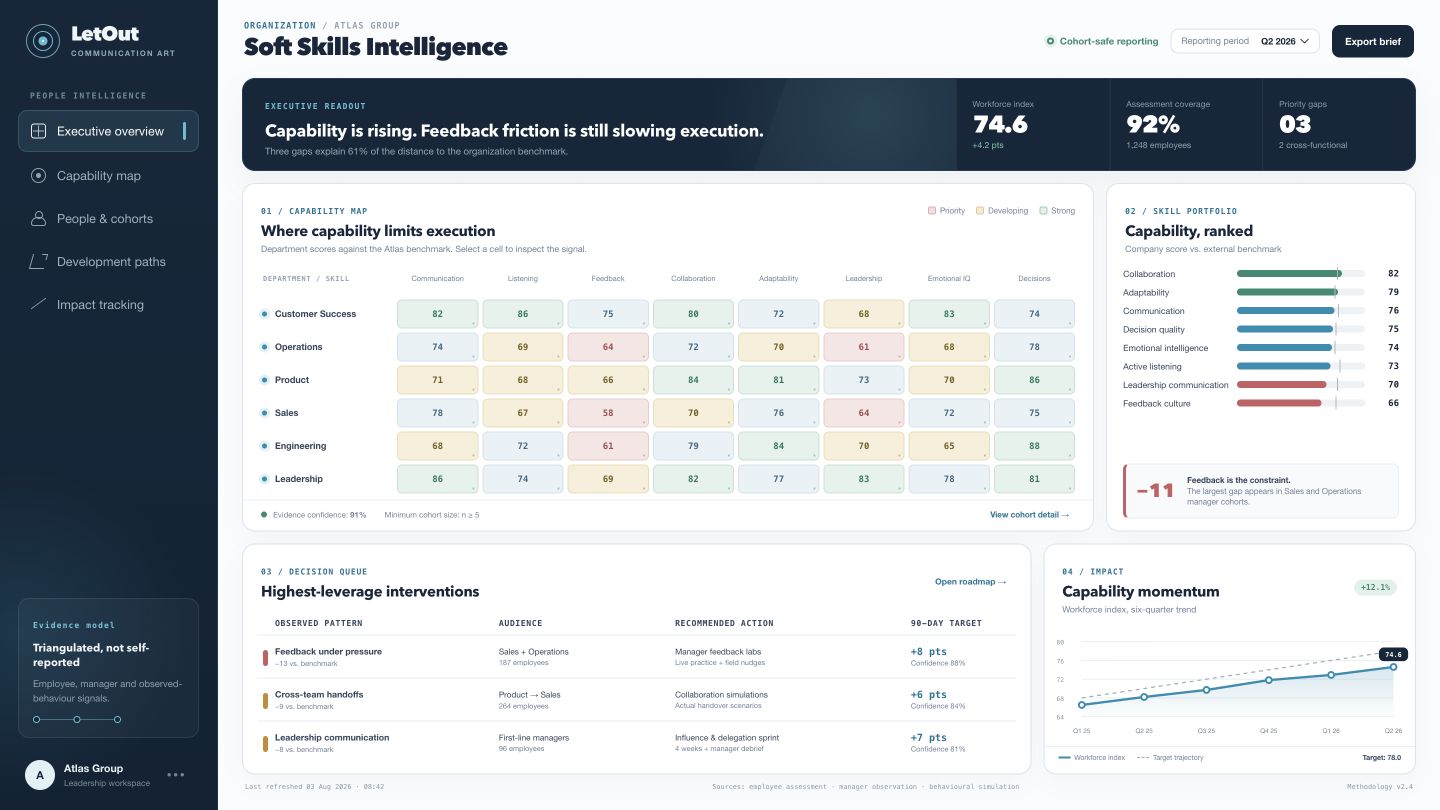
Dashboard data shown for illustration. The final framework is calibrated to each organization.
03 THE COMPLETE SYSTEM
Assessment is the beginning.
Development is the work.
Let Out connects diagnosis, organizational insight, individual development and measurable follow-up in one coherent journey.
Soft-skills assessment
Understand how people communicate, collaborate, lead and adapt before choosing the intervention.
↗Organization insight
See strengths, gaps and patterns across departments, roles and leadership levels in one clear view.
↗Targeted development
Build training, coaching and manager support around the behaviours the evidence actually reveals.
↗Progress measurement
Track individual and team development over time, then adjust the pathway as needs change.
↗04 WHAT YOU RECEIVE
A decision system.
Not a report that sits in a folder.
Everything is designed to help leaders choose what happens next—and help employees understand how to grow.
01Executive summary
02Department dashboard
03Individual employee scorecards
04Behavioural analysis
05Development priorities
06Learning roadmap
07Management debrief
08Impact review
BLFCASE EXAMPLE
05 BANQUE LIBANO-FRANÇAISE
A banking program built from real client interactions.
Communication and proactive client engagement
Identify the communication behaviours affecting proactive client engagement.
Understand branch realities, identify gaps and build realistic banking simulations.
A tailored development program aligned with daily responsibilities and client conversations.
A LOW-RISK WAY TO START
Begin with one focused diagnostic pilot.
Choose one department, role or leadership group. We assess the pattern, present the insight and agree the right development roadmap.
01 Align scope02 Assess sample03 Present insight04 Agree roadmap
06 COMMON QUESTIONS
Clear answers.
Before you start.
No. Let Out starts by identifying the behavioural patterns affecting performance. Training is recommended only when it is the right response to the evidence.
The framework is calibrated to your organization and can cover communication, listening, feedback, collaboration, leadership, adaptability, emotional intelligence and other workplace behaviours.
Each employee receives a private development scorecard showing current levels, strengths, priority gaps, a recommended pathway and progress over time.
Leadership dashboards are designed around appropriate role permissions and cohort-safe reporting. Individual development data can be kept private while leaders see the patterns required for workforce decisions.
Begin with a focused diagnostic pilot for one department, role or leadership group. The pilot establishes relevance before you scale.